Cyber Attack Prediction with evidence and knowledge
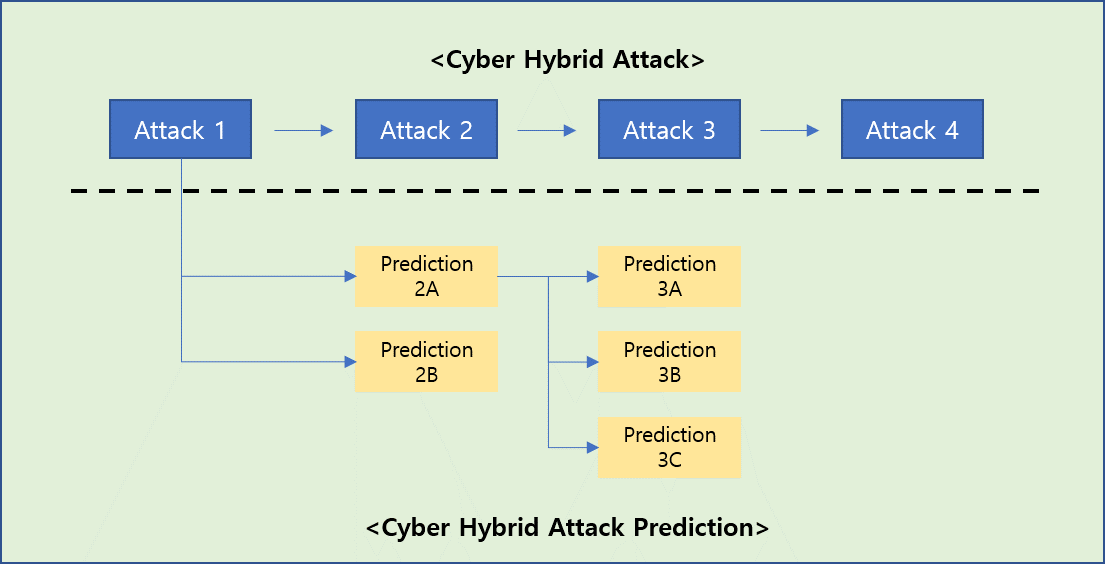
Figure Figure Conceptual Diagram of Cyber Attack Prediction.
A Cyber Hybrid Attack refers to an advanced threat in which adversaries combine multiple, heterogeneous attack techniques concurrently or sequentially rather than relying on a single vector. By orchestrating social engineering, malware deployment, vulnerability exploitation, lateral movement, data manipulation, encrypted C2 channels, and denial-of-service operations in a coordinated chain, attackers exploit detection gaps across disparate security layers. Because each stage often appears independent, single-event analysis fails to expose the full intrusion, enabling APT groups or highly skilled actors to operate stealthily over extended periods. This multifaceted structure significantly expands the impact and complexity of the attack, making comprehensive detection, attribution, and response far more challenging.
Cyber threat prediction can begin by identifying an initial attack indicator and generating k likely subsequent tactics or techniques (TTPs), then recursively predicting the next possible steps for each of those outcomes. This predictive structure focuses on modeling transition patterns within the entire attack sequence, rather than analyzing isolated events. By leveraging historical threat data, TTP transition probabilities, graph-based attack path analysis, and behavioral patterns associated with specific adversary groups, the model can estimate the most probable next-stage actions. This enables organizations to move beyond simple alert handling and instead anticipate future attack flows, potential intrusion paths, and adversary intent, allowing for more proactive and strategic defense preparation.